


The options collar strategy enables an investor to deploy large sums of money into their favorite bullish stock while maintaining tight risk management to protect that investment.
We will use Alphabet (GOOGL) as an example.
Contents
- The Setup
- Selling A Bear Call Spread
- Take Profit On The Bear Call Spread
- Rolling The Collar Up For More Profits
- Summary
The Setup
Let’s say an investor buys 100 shares of GOOGL on January 2nd, 2026.
She pays $315.46 per share, which equates to a $31,546 investment.
She then buys one contract put option at a strike price of $310 with an expiration of March 20, 2026 – about 77 days out in the future.
This contract will protect her investment because she can sell 100 shares of GOOGL at $310 per share at any time before or at expiration.
She pays $1,608 for this one contract.
To finance this cost, she sells one call option contract with a strike price of $325.
This means that her 100 shares could get called away (or sold) at $325 per share if GOOGL reaches or surpasses $325 at expiration.
She receives a $1,662 credit for the sale of this contract.
When this is all entered into analytical software, you get the following payoff graph…
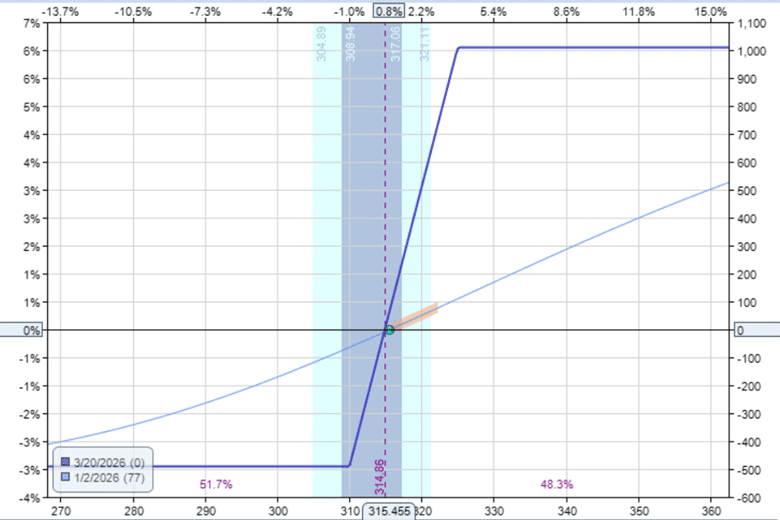
The collar is a bullish strategy, which we want the stock to go up.
The maximum risk for this position is $500, and the maximum potential profit is $1000.
The investment has a collar that caps both the upside and the downside.
Selling A Bear Call Spread
Alphabet is off to a great start in the first two weeks of the year, running up to $335 per share.
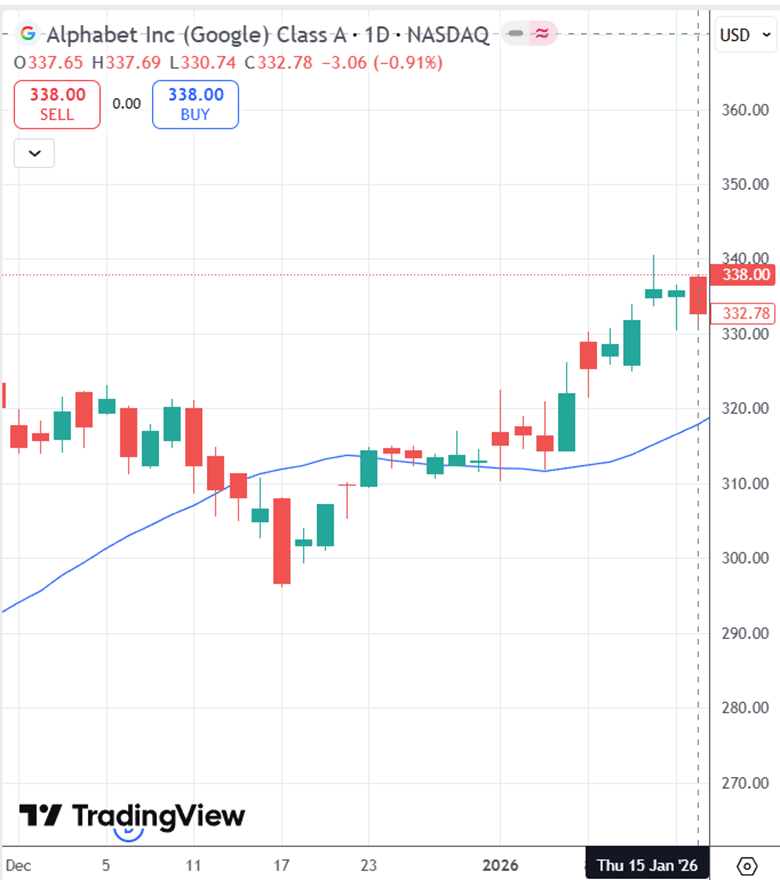
The investor notes that the stock is extended above the 20-day simple moving average and has stalled around $335.
This is her current position, with a gain of $273, representing about a 2% return on the investment to date.
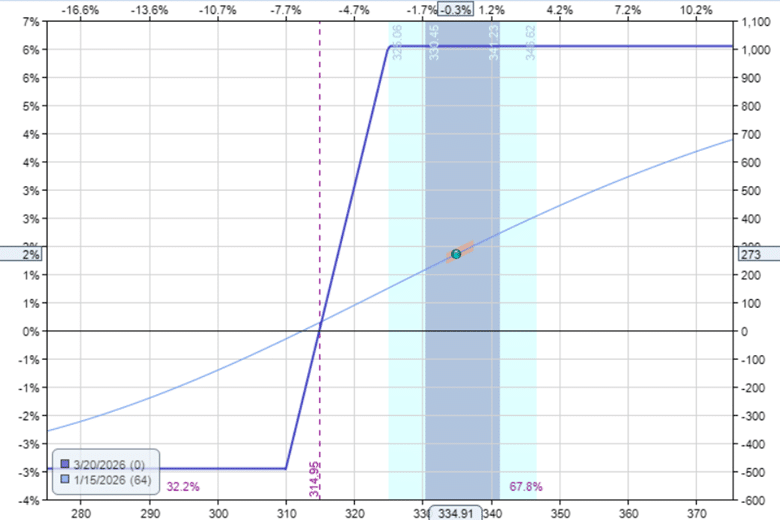
Expecting that a potential pullback is near, she sells a bear call spread on top of her existing collar.
Date: Jan 15, 2026
Price: GOOGL at $334.91
Sell one contract Mar 20 GOOGL $325 call @ $26.20
Buy one contract Mar 20 GOOGL $340 call @ $18.33
Credit: $787
Note that the short call in the spread is the same strike as the short call in the collar.
The bear call spread has the same expiration as the collar.
The resulting position looks like an options butterfly…
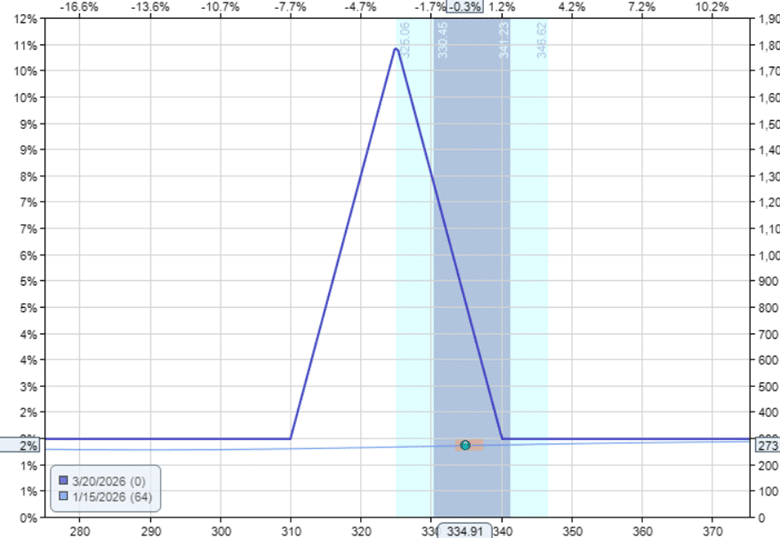
More interestingly, the expiration graph shows that this position has no further risk.
The minimal profit is $273.
This is because the credit from the bear call spread exceeds the trade’s original maximum risk.
Take Profit On The Bear Call Spread.
This investor must have strong predictive (or, rather, chart-reading) abilities, as the stock pulled back to the 20-day simple moving average.
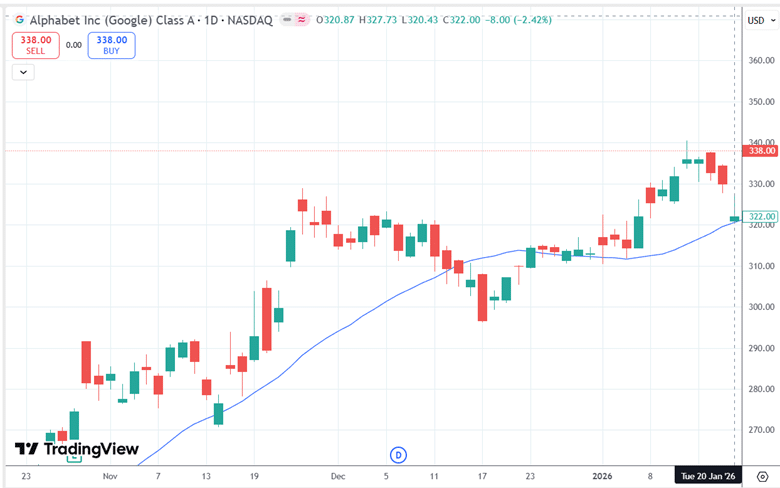
When the stock goes down, the bear call spread profits.
The investor takes profit by closing the spread.
Date: Jan 20, 2026
Price: GOOGL at $324
Buy to close one contract Mar 20 GOOGL $325 call @ $19.30
Sell to close one contract Mar 20 GOOGL $340 call @ $12.75
Debit: -$655
Sold for $787 and bought back at $655, she made a profit of $132.
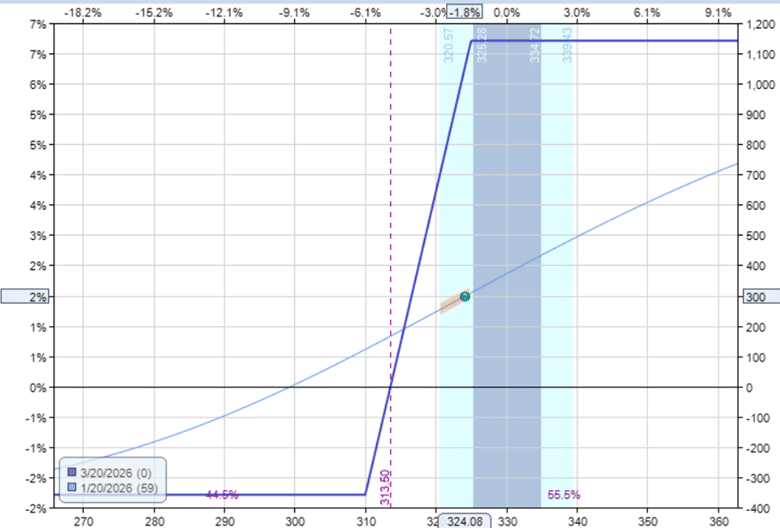
The remaining collar position now looks like this:
Rolling The Collar Up For More Profits
By the end of the month on January 30th, 2026, Alphabet continued up in price to $337
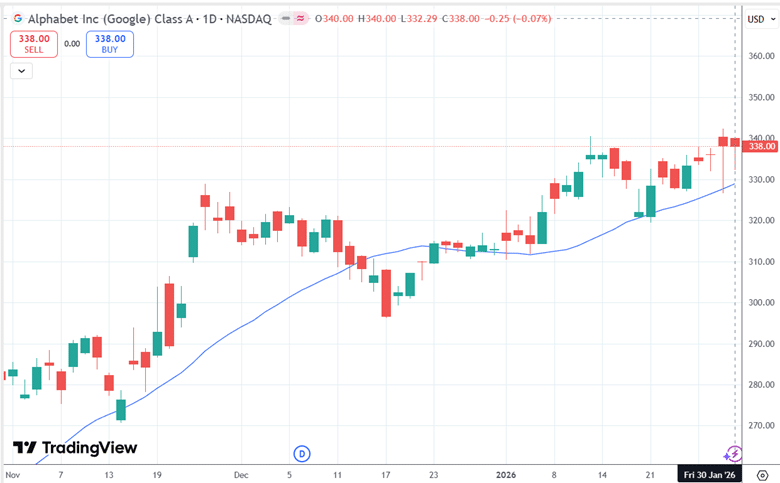
The profit in the position is $517…
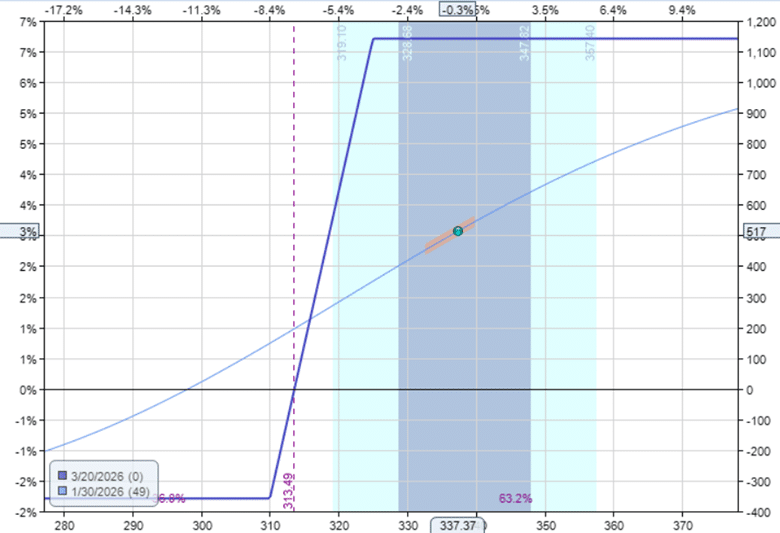
The investor decides to roll the collar up.
She cannot move the stock price.
However, she can roll the put strike up by 25 points, and she can roll the call strike up by 25 points.
She rolls the call strike up in a single order:
Date: Jan 30, 2026
Price: GOOGL at $339.23
Buy to close one contract Mar 20 GOOGL $325 call @ $26.50
Sell to open one contract Mar 20 GOOGL $350 call @ $13.60
Debit: -$1290
And she rolls the put strike up in another order:
Sell to close one contract Mar 20 GOOGL $310 put @ $6.30
Buy to open one contract Mar 20 GOOGL $335 put @ $14.85
Debit: -$855
The adjustment does cost money.
But look at the resulting payoff graph…
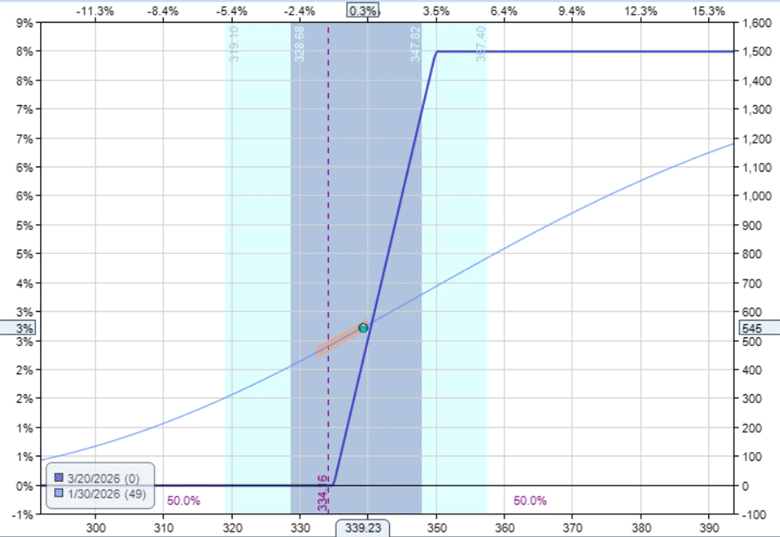
There is no longer any risk in the trade, and the maximum potential profit has increased to $1500, whereas before it was capped at $1150.
Summary
Summarizing her transactions:
Initial value of 100 shares: $31,546
Buy put for the collar: -$1,608
Sell call for the collar: $1,662
Profit from bear call spread: $132
Cost of rolling the call up: -$1,290
Cost of rolling the put up: -$855
Current value of 100 shares: $33,923
The stock has run up 7% in one month.
Had she not used the collar and just held long stock, she would have made $2,377 on the 100 shares.
The collar protected her investment but reduced her returns.
Her profit of $545 with a capital usage of $33,691 yields a 1.6% return in one month, which is not bad given the level of protection the collar provided.
The two ways in which she enhanced the potential profits of the collar were by
- Selling a bear call spread during a stock pullback.
- Rolling the collar up to increase upside potential.
This was an example of an options collar, where everything worked out well with the stock going up.
Stay tuned for an options collar example in which the stock declined, and see how well the collar protected the investment.
We hope you enjoyed this article on two ways to increase the profitability of options collars.
If you have any questions, please send an email or leave a comment below.
Trade safe!
Disclaimer: The information above is for educational purposes only and should not be treated as investment advice. The strategy presented would not be suitable for investors who are not familiar with exchange traded options. Any readers interested in this strategy should do their own research and seek advice from a licensed financial adviser.
Original source: https://optionstradingiq.com/increase-the-profitability-of-options-collars/